How Casino Stories Use Huế as a Dramatic Setting
Learn how casino stories use Huế to shape character, mood, and tension, and how to interpret those choices without mistaking drama for cultural fact.
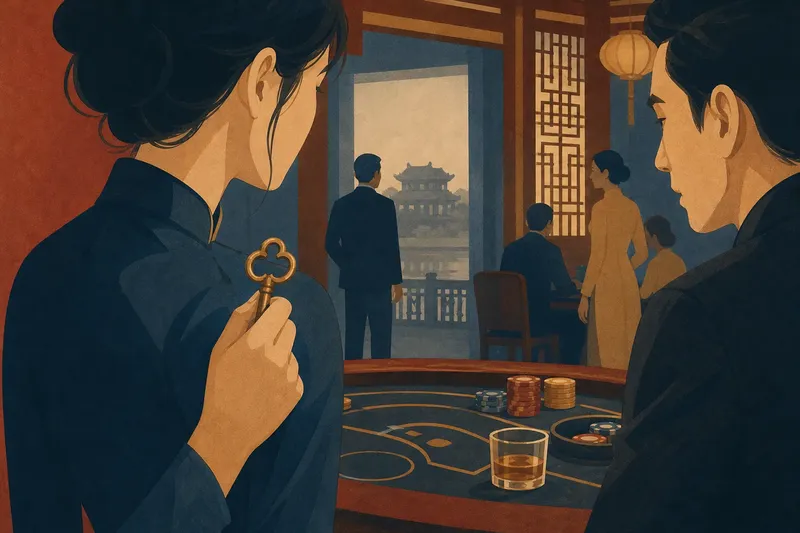
The most common mistake in reading a casino story set in Huế is treating the setting as a decorative backdrop; it costs the scene its meaning. A casino story about Huế can use local references, objects, and social encounters to shape what characters want and what they fear, even when the events are invented.
Instead of asking only whether a scene looks convincing, ask what its details make the audience notice. A character’s hesitation, a room’s arrangement, or a phrase exchanged across a table may reveal how the story imagines trust, status, or risk.
Casino stories make social choices visible
A casino setting brings chance and public display together. That combination lets a writer place a private decision in a space where other people can watch, judge, or misunderstand it.
Notice who gets to move freely, who waits, and who controls the conversation. These choices can make power visible without explaining it in dialogue. A guarded doorway might signal a character’s exclusion; a shared table might create an uneasy alliance.
The useful question is not simply what the casino symbolizes, but how a particular character experiences it. For one person it may represent opportunity; for another, exposure or a loss of control.
Regional details shape the story’s point of view
A story’s references to Huế can do more than locate the action. Names, speech, food, streets, and relationships may show which parts of local life the creator considers relevant to the characters’ choices.
Pay attention to whose knowledge the story trusts. Does a local character explain a place to an outsider, or does the plot let that character act without turning them into a guide? Does regional language carry humor, authority, intimacy, or conflict? Such decisions reveal a narrative point of view, not a complete account of the region.
Representation is selective by nature. A scene may use one location or custom to frame a character’s experience, while leaving other lives and perspectives beyond the camera. Reading that selection carefully is more useful than assuming a single story speaks for everyone in Huế.
Objects and dialogue carry cultural meaning
Small details can change how an audience reads a scene. A formal greeting may establish distance; a familiar form of address may suggest closeness or rank. A borrowed phrase can sound warm, awkward, or dismissive depending on who says it and how others respond.
Objects work in a similar way. A family keepsake brought into a public space may connect a character to obligations outside the casino. A card, an envelope, or a piece of clothing may carry meaning because of its place in the character’s life, not because it has one fixed cultural meaning.
Read the detail in context: who introduces it, who recognizes it, and what changes after it appears? This keeps interpretation grounded in the scene rather than turning a single object into a broad claim about a culture.
How can readers interpret a casino story about Huế?
What does a casino setting add to a story?
It places uncertainty in a social space, where decisions can be watched and judged. The setting can therefore sharpen conflicts about trust, status, or belonging.
Can one character represent Huế?
One character can express a particular perspective, but a character is not a stand-in for every resident. Look at whose experiences the story includes and whose remain outside its frame.
How should readers interpret unfamiliar local language?
Use the surrounding exchange: note who speaks, who understands, and how the words affect the relationship. If the meaning remains unclear, avoid treating a guess as a cultural rule.
What makes a regional reference feel meaningful?
A reference matters when it affects character, relationships, or the story’s sense of place. If removing it would change nothing in the scene, it may be decorative rather than integral.
Use a close-reading method that follows the scene
Work through a scene in a fixed order: identify a concrete detail, note the character who encounters it, observe what happens next, then state what the sequence supports—and what it does not. This is like sorting objects into separate trays: keeping observation apart from interpretation makes each easier to check.
- Observe who speaks first. If one character consistently controls the exchange, read the scene for authority; if turns are shared, consider whether the dialogue presents a more balanced relationship.
- Observe who recognizes a local reference. If only one character understands it, treat that as a difference in knowledge; if several respond naturally, consider how shared familiarity connects them.
- Observe what an object prompts. If it changes a character’s action or another person’s response, interpret it as part of the conflict; if nothing follows, treat it as atmosphere rather than evidence of a broad custom.
- Observe how the camera frames the room. If it repeatedly isolates one character, consider how the scene creates vulnerability; if it keeps several people in view, consider how their relationships shape the tension.
- Observe the response to regional language. If the response signals warmth, discomfort, or correction, use that reaction to interpret the exchange; if no response clarifies the meaning, leave the interpretation open.
- Observe what the scene omits. If the plot leaves out ordinary social context, read the scene as a focused dramatic moment; if it supplies several perspectives, consider how those perspectives complicate the central character’s view.
Say you are watching an invented short film about Linh, a hotel clerk in Huế, who enters a fictional casino carrying her late grandmother’s brass key. First, note the key and its clear starting role: Linh brings it into a place where she expects to meet a former colleague. Next, observe that the colleague asks about the key and Linh closes her hand around it before answering. Then note that the camera cuts to the colleague’s face rather than showing what Linh does afterward. The scene supports a reading that the key links Linh’s private obligations to a tense meeting; it does not establish what brass keys mean in Huế, or describe any real casino. The tradeoff is clear: the interpretation stays specific to the film, while broader cultural claims remain unanswered.
What a casino story can reveal about Huế
A casino story about Huế can reveal how its creators connect regional identity with character, language, and dramatic pressure. It can also invite audiences to notice which perspectives receive attention and which are left out.
Keep an observation separate from an interpretation: “the character pauses after hearing a familiar form of address” describes an event in the scene, while “the pause suggests discomfort” offers a reading. That distinction lets you take the story’s cultural choices seriously without asking one fictional scene to stand for a whole place.